By We Level Up | Author Alex Evans, PharmD, MBA | Editorial Policy | Research Policy
Welcome to our Modafinil vs Adderall Comprehensive Guide. We’ll examine A Balanced Clinical Comparison of Uses, Risks & Evidence options.
Modafinil and Adderall are two well-known stimulants often compared for their ability to enhance focus, alertness, and productivity. Both can help with attention and reduce tiredness. However, they work differently. They also have different approved medical uses and risks for dependence or side effects. This clinical comparison looks at the main differences between Modafinil and Adderall. It covers how they work, their benefits, risks, and research findings. This information can help you make safer, informed choices with professional guidance.
What is the Difference Between Modafinil and Adderall?
While comparing Modafinil vs. Adderall, you will note that both drugs are stimulants. Prescription stimulants help treat ADHD (attention-deficit hyperactivity disorder). They are also used to stay awake and reduce appetite. [1] Adderall tends to be more potent. It has a higher chance of abuse and addiction. Modafinil is seen as having a lower chance of abuse. Both Modafinil and Adderall are used to treat similar conditions, but work differently. Modafinil is mainly used to reduce excessive daytime sleepiness associated with narcolepsy, sleep apnea, and shift work sleep disorder. It works by increasing dopamine and histamine in the brain. This helps you feel awake and alert without the strong stimulation that Adderall causes.
Adderall, on the other hand, is mainly used to treat ADHD and narcolepsy. It contains amphetamine and dextroamphetamine. These compounds stimulate the central nervous system. They increase the release of norepinephrine and dopamine in the brain. This helps improve attention, focus, and alertness.
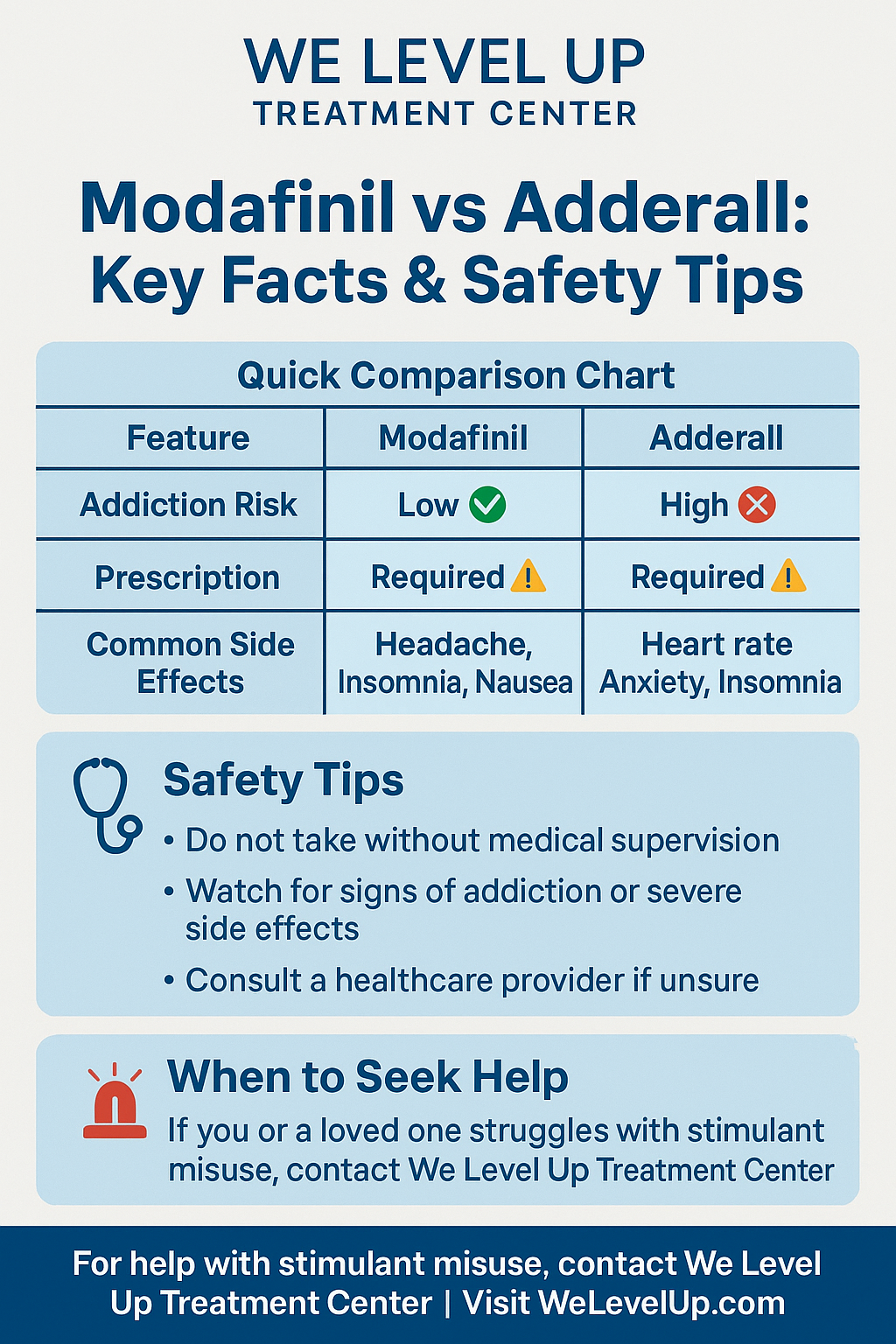
Modafinil is a wakefulness-promoting agent (Schedule IV, indicating a lower risk of misuse). Whereas Adderall is an amphetamine stimulant for ADHD (Schedule II, higher misuse risk). Do not combine them without consulting a clinician.
Risks, Timelines, and Safer Treatment Options
The combination of Modafinil and Adderall increases the risk of overstimulation, rapid heartbeat, and elevated blood pressure. Both drugs impact the brain’s alertness areas. When used together, they can lead to anxiety, restlessness, and trouble sleeping. Modafinil and Adderall may each strain the heart and nervous system on their own — when used together, the risks can multiply. It is very important to avoid mixing Modafinil and Adderall without medical supervision. This helps reduce dangerous side effects and keeps you safe.
The medical information on this page is provided for educational purposes only and should not replace professional medical advice. If someone has taken Modafinil with Adderall and experiences chest pain, confusion, severe agitation, or trouble breathing, call 911 immediately. If you think it may be an overdose, do not wait. For 24/7 emotional support in the U.S., call or text 988 (Suicide & Crisis Lifeline).
Key Takeaways from Modafinil vs Adderall Comparison:
- Adderall (Schedule II) has a higher risk of abuse and dependence than Modafinil (Schedule IV).
- Modafinil is often used to treat sleep disorders such as narcolepsy, while Adderall is primarily prescribed for ADHD.
- Modafinil can work for 12 to 15 hours. Adderall usually lasts 4 to 12 hours, depending on the type.
- Combining these stimulants can increase risks such as anxiety, insomnia, and heart strain.
- Always follow medical guidance when starting, stopping, or switching between Modafinil and Adderall.
Modafinil Vs Adderall ADHD Medication
Modafinil has been assessed as a potentially effective medication in lessening problematic symptoms of ADHD. Modafinil is not FDA-approved for treating ADHD, but may be prescribed off-label. The US Food and Drug Administration approved this drug to help adults stay awake. It is for those with excessive sleepiness from narcolepsy, obstructive sleep apnea, or shift work sleep disorder. However, we do not fully understand how it works in people. [2]
Amphetamine-mixed salts, including Adderall, are FDA-approved for treating ADHD and narcolepsy. However, the misuse of stimulants like Adderall has increased a lot in recent years. This is due to students’ misunderstandings or a lack of knowledge about the risks involved. [4]
Modafinil Vs Adderall Addiction
Stimulants are classified as Schedule II drugs, which provide positive medicinal effects and considerable abuse potential. The nonmedical use of stimulants is the second most common illegal use in college. It is only behind marijuana use disorder. Many people see stimulants, whether prescribed or illegal, as an easy way to boost performance or feel good.
When comparing modafinil to Adderall, it’s essential to understand the differences in regulation and associated risks. Adderall is a Schedule II controlled substance. It has a higher risk of misuse (see CDC study) and dependency. Modafinil, also called Provigil, is a Schedule IV medication. It stimulates the central nervous system and has a much lower risk of abuse. Understanding these differences can help guide safer choices in stimulant use and recovery.
Modafinil Vs Adderall Dosage
The typical adult dose of Modafinil is 100 mg to 200 mg, taken orally daily in the morning. Suppose you take more than that; it may cause sleep disturbances at night. The medication is typically used for 12 weeks or less.
The individual’s age and needs determine the Adderall dose for ADHD. The recommended dose for people with ADHD starting treatment for the first time is 20 mg each day. The usual dose for narcolepsy is 5 mg to 60 mg per day in split doses, depending on the person’s reaction. Addicted Adderall users often snort the drug in amounts much higher than recommended. This can harm their lungs, sinuses, and nasal linings. When Adderall usage suggestions are not followed, they may undergo hyperactivity, sleeplessness, irritability, and personality changes.
Learn More:
Skip To:

Get Your Life Back
Find Hope & Recovery. Get Safe Comfortable Detox, Addiction Rehab & Dual Diagnosis Trused Care.
7/365 Line (844) 597-1011Modafinil Vs Adderall Addiction Statistics
Administration of prescription stimulants can be complicated because of the risk of drug addiction and misuse. Patients may use this without a prescription. They might use it for reasons other than what a doctor said. They may also take more than prescribed, use it more often, or use it for a longer time. Understanding how the use of these medications relates to misuse is crucial because stimulant abuse is common. [5]
11 Million
4.5 percent, or roughly 11.0 million, used prescription stimulants without misuse.
Source: NIH
900,000
Roughly 900,000 US citizens abuse prescription stimulants every month.
Source: NIH
8.7%
Among those adults with prescription stimulant misuse, 8.7 percent had prescription stimulant use disorders.
Source: NIH
Adderall Vs Modafinil Off-Label Uses
While these medications have known uses, they are often given for benefits they are not officially approved to treat. This is true for a wide range of drugs.
Off-label Adderall applications are intended to take advantage of its stimulant properties. Adderall can help with weight loss, boost alertness, and treat obesity concerns.
Modafinil is also given to help with illnesses that its stimulant effects can improve. This includes tiredness and low energy in people with multiple sclerosis or Parkinson’s disease. It is also used for cancer patients and those with severe depression who feel exhausted.
When comparing modafinil vs Adderall, research shows that modafinil is a considerably weaker stimulant than Adderall. Its qualities make it useful in addressing lethargy and drowsiness without triggering anxiety, jitteriness, irritability, or agitation. Adderall, on the other hand, is a more potent stimulant and should always be used with caution.
Modafinil is not approved for treating ADHD, but may be prescribed off-label. At this time, some small controlled studies suggest Modafinil is a valuable treatment for ADHD. Research studies have indicated that Modafinil:
- It may be significantly more effective in treating the symptoms of ADHD than a placebo.
- It may have comparable effectiveness for ADHD treatment to Ritalin and Concerta, and fewer side effects.
- It may have similar efficacy for ADHD treatment compared to dextroamphetamine (one of the components in Adderall).
It should be mentioned that Modafinil is not an FDA-approved ADHD medicine. Insurance companies may refuse to cover the medicine if prescribed for this purpose.
Modafinil Vs Adderall Weight Loss Medication
Modafinil and Adderall do not directly work on weight, and their potential might help weight loss pursuits is more of a side effect. Both Modafinil and Adderall have been found to contribute to weight loss. Adderall seems to be especially effective at this. Researchers say Modafinil may be better than Adderall for this use. It has fewer Adderall side effects and a lower risk of addiction.
What Is Adderall Used For?
Adderall and other amphetamines are called “brain boosters” and “study drugs.” Some students think these drugs help them think better. Adderall does not make someone more skilled. However, it can make a person feel smarter by boosting motivation. Also, it can cause side effects like hallucinations, epilepsy, psychosis, and malnutrition.
The prolonged use of Adderall can lead to addiction and its associated risks. Contrary to what many teens — and even some parents — believe about abusing Adderall, amphetamine is highly addictive.
Prescription stimulants are usually safe for those prescribed, but even people under the supervision of a doctor are at risk of developing an addiction. Those who use Adderall without medical assistance to get high or fuel all-night study sessions are at risk of developing an addiction. Because of the risk of Adderall addiction, the US government classified it like cocaine and methamphetamine.
When comparing modafinil to Adderall, it’s essential to understand the differences in regulation and associated risks. Adderall is a Schedule II controlled substance. It has a higher risk of misuse and dependency. Modafinil, also called Provigil, is a Schedule IV medication. It stimulates the central nervous system and has a much lower risk of abuse. Understanding these differences can help guide safer choices in stimulant use and recovery.
How Addictive is Adderall?
The symptoms above can worry a person. However, there are also signs of Adderall addiction to watch for. Because Adderall is a prescription substance, individuals can “doctor shop” to obtain a large quantity of it. These people usually go to multiple pharmacies to fill prescriptions while avoiding notice. A worried person may discover prescription bottles from different doctors and pharmacies; this is a significant indicator of misuse.
Adderall can be purchased on the street or through friends, family, coworkers, or classmates. Since Adderall is a prescription drug, people can obtain it in various ways. However, these methods can leave evidence that helps detect signs of Adderall addiction.
Injections
There are several behavioral markers of Adderall usage, but the individual’s specific habits determine the symptoms that arise. A person who injects Adderall, for example, will require the necessary equipment. This contains a syringe, a spoon (typically with heating markings), a heating device or lighter, a belt or rope (to bind a limb and make it easier to identify a vein), and anything capable of breaking Adderall (things such as an espresso stopper, a hammer, or a mortar and pestle).
Crushing Pills
Someone who snorts Adderall will need something to shatter the tablets (Adderall does not come in powder form). A straw, a rolled-up bill, a hollowed-out pen, or something similar can snort crushed Adderall. A person can use anything sharp, like a credit card, to make Adderall lines. If found, it may have residue on the edge.
Evidence-Based Studies about Modafinil vs Adderall with Insights
Stimulant medications like Adderall and modafinil are often compared. But their effects, risks, and benefits are different. At We Level Up Treatment Centers, we don’t just look at medications alone. We examine what studies show about their effects, risks, and benefits. Then we ask: what does this mean for real people in recovery? That’s how we turn research into care that helps each client move forward safely.
The studies below teach us important lessons. They show us how to relieve symptoms and protect our long-term health. They also help prevent relapse.
How We Level Up Turns Research Into Real Recovery
At We Level Up, we know that recovery is more than just changing one pill for another. It’s about making a treatment plan that fits your unique story, needs, and goals. Our medical and therapy teams use the latest research on medications on Adderall vs modafinil. They carefully consider the benefits and risks for each person.
Is Adderall increasing risks to your heart and mental health? We Level Up can help explore safer alternatives. If modafinil seems more suitable, we will closely monitor your progress. We’ll review your treatment plan to ensure it works effectively without unwanted side effects. Every plan includes medication management and therapy based on evidence. This way, recovery focuses on your symptoms and your overall well-being for long-term success.
| Study | Treatment Implications | Insights for Patients |
|---|---|---|
| Modafinil Versus Amphetamine-Dextroamphetamine For Narcolepsy Type 2 & Idiopathic Hypersomnia (randomized, fully-blinded non-inferiority trial). View Study | Modafinil and amphetamine-dextroamphetamine both improved daytime sleepiness in the disorders studied. | If your doctor prescribes modafinil instead of Adderall for sleep disorders, you may see similar improvements in wakefulness. However, side effects and responses can differ. Be sure to tell your doctor about any mood changes, insomnia, or heart symptoms. |
| Behavioral and subjective effects of d-amphetamine and modafinil: comparison in healthy volunteers (Makris et al., 2007) View Resource | For off-label cognitive use, doctors should know that amphetamines can have stronger effects. This means they may be more likely to be abused. Modafinil may be preferable when a lower subjective stimulant effect is desired. | Modafinil often feels “less like a classic stimulant” to many users. This can lead to fewer cravings and a lower risk of abuse. However, users should still be aware of possible anxiety, insomnia, or rare psychiatric reactions. |
| Efficacy of Mixed Amphetamine Salts (Adderall) in Adults with ADHD — randomized controlled trial (Spencer et al., 2001) Read Study | Adderall is proven to help reduce ADHD symptoms in adults. Use the right dose based on evidence. Also, watch for heart and mental health side effects. Consider baseline EKG if cardiac risk factors are present. | Adderall is a helpful option for ADHD. If you are prescribed it, have follow-ups to check your blood pressure, mood, sleep, and any signs of misuse. |
| Comparison of modafinil and methylphenidate for excessive daytime sleepiness — comparative clinical studies (Chitsaz et al., 2024; Sheikhina et al., 2021) Read Review | Choice among wakefulness agents (modafinil, methylphenidate, amphetamines) should be individualized — consider comorbidities, cardiovascular risk, abuse potential, and interactions. | Talk about your goals, like improving daytime functioning or treating ADHD symptoms. Discuss side effects you can handle, such as appetite loss or insomnia. Also, consider your personal and family history with substance use when picking between these medicines. |
What This Means for Your Care at We Level Up
The strong message is this: recovery is not just about picking modafinil or Adderall. It’s about creating a safe, personal, and lasting way to move forward. The research shows that Adderall can be effective. However, it has higher risks of dependence and long-term health problems. Modafinil may be safer for some people, but it is not without risks.
At We Level Up addiction treatment centers, we use this evidence to help you. We create personalized recovery programs for stimulant addiction. Our programs focus on your overall health, not just one prescription. We provide 24/7 medical and therapy support. We guide safe Adderall rehab or modafinil treatment when needed. We also teach relapse-prevention strategies, offer therapy, and provide holistic care. The goal is lasting recovery, helping you rebuild focus, energy, and purpose. At We Level Up, science and compassion come together to give you the tools for real healing and long-term success.
First-class Facilities & Amenities
Trusted Integrated Addiction & Mental Health Rehabilitation Treatment
Rehab Centers TourEstablished Addiction Centers. Serene Private Facilities. Inpatient rehab programs vary.
Addiction Helpline (844) 597-1011Comprehensive recovery success experience, backed by a Team w/ History of:
15+
Years of Unified Experience
100s
5-Star Reviews Across Our Centers
10K
Recovery Success Stories Across Our Network
- Low Patient to Therapist Ratio
- Onsite Medical Detox Center
- Comprehensive Dual-Diagnosis Treatment
- Complimentary Family & Alumni Programs
- Alumni Coaching, Recovery & Personal Development Events
Signs Of Stimulant Abuse

Modafinil vs Adderall can help a person focus in small doses. However, calling them smart drugs is not right. The long-term effects of these medications in terms of their capacity to improve academic performance are greatly exaggerated. Most people who misuse drugs like Adderall perform worse in school than those who do not take these substances as cognitive enhancers.
The misuse of stimulants has garnered much attention, notably the abuse of methamphetamine (meth), cocaine, and ADHD drugs such as methylphenidate (e.g., Ritalin and Concerta) and Adderall. Over-the-counter stimulants may be misused with other medications to reduce weight and induce euphoria for various reasons. Long-term stimulant usage can severely affect one’s physical and mental health.
These two drugs are thought to have quite different abuse potentials. Adderall is well-known for its high propensity for misuse. People often abuse Adderall to take advantage of its stimulant effects. They see it as a “cognitive enhancer” to help with weight loss. Some also mix it with other drugs for its psychedelic effects. Abuse of Modafinil appears to be primarily related to seeking to employ its stimulant characteristics as a cognitive enhancer.
The term cognitive enhancer refers to a chemical that can make someone smarter. Because of this, people often call these drugs smart drugs. There are, however, no medications that make individuals smarter. Stimulants like coffee, Adderall, and Modafinil can help people pay attention and focus. However, when taken in moderate to high doses, they can reduce this ability.
Many studies have shown that Adderall can be misused. This is especially true for high school and college students. Younger people in high-pressure jobs and those trying to lose weight, mainly females, are also at risk. Adderall is a common drug that people misuse. It is often taken with other substances like alcohol. It can quickly lead to physical dependence in regular users.
Modafinil has a far lower abuse risk than Adderall. This does not imply that Modafinil cannot be misused; nevertheless, it is less likely to be abused. Research shows that there is little evidence that using Modafinil leads to tolerance. Withdrawal symptoms are rare. Only a few case studies have shown signs of Modafinil dependency. The substance does not appear to induce euphoria, commonly associated with other stimulants. Withdrawal symptoms like apathy, tiredness, and cravings were mostly emotional in the few case studies that suggested physical dependency.
Modafinil Vs Adderall Differences
The main difference between Modafinil vs Adderall is their structure. This leads to important differences in their risk of addiction and side effects. Modafinil is a Schedule IV controlled substance, while Adderall is a Schedule II controlled substance. For this reason, Modafinil is usually not classified as a stimulant but as a wakefulness-promoting agent. Unlike Adderall, Modafinil is not approved for treating ADHD, even though some studies have suggested that it helps treat impulsivity symptoms in ADHD patients.
- Is Modafinil better than Adderall? Modafinil is a psychostimulant that promotes wakefulness, while Adderall is a central nervous system stimulant.
- Is Modafinil like Adderall? Both Adderall and Modafinil can be used for treating (see NIH study) excessive sleepiness and narcolepsy.
- Both Modafinil and Adderall are sometimes referred to as “smart drugs.” These prescription drugs can enhance decision-making capacities, cognitive function, and wakefulness.
- Is Adderall better than Modafinil? Both Adderall and Modafinil are known to cause some severe side effects. They share similar side effects, such as loss of appetite, increased heart and blood pressure, dizziness, and insomnia.
Modafinil Vs Adderall Addiction Risks
Both Adderall and Modafinil can be addictive and have side effects. When we compare the side effects of Modafinil and Adderall, we find that Modafinil is less addictive. Adderall has a higher potential for addiction. Adderall also has more serious side effects. For instance, some severe side effects of Adderall include seizures, hallucinations, changes in heart rate, and increased blood pressure. Adderall should not be taken without a doctor’s approval. Some people who use it regularly may struggle to function without it.
Modafinil vs Adderall? Modafinil is a milder stimulant than Adderall. This allows it to be used in more situations for sleep disorders like obstructive sleep apnea. In addition, it has less potential for inducing irritability, anxiety, and agitation.
Stimulants & Adderall Addiction Treatment
There are no approved medications to help treat an Adderall addiction. Instead, treatment is focused on supervising a person as they go through a detoxification process. Withdrawal from stimulants like Adderall can be highly uncomfortable and stressful for the body. The doctor will refer the person to an inpatient or outpatient rehabilitation center or detox facility.
During drug addiction rehab, doctors will help the person with withdrawal. They will make it easier to handle any symptoms. It’s not recommended that someone quit Adderall cold turkey. Instead, the doctor will slowly lower the dosage under medical supervision. This is called tapering.
Steps for treating an Adderall addiction:
- Enroll in a supervised detox or rehab program.
- Get a medical evaluation and assessment.
- Taper Adderall under medical supervision.
- Manage withdrawal symptoms.
- Undergo psychotherapy or behavioral therapy.
- Develop an aftercare plan. This can include attending ongoing individual and group psychotherapy conducted by licensed therapists.
Patient Stories
These examples reflect illustrative patient experiences. Names and details have been altered for privacy purposes.
- “J., 32 — Managing ADHD and Career Demands”
J. struggled to maintain focus at work due to ADHD. After discussing options with his physician, he was prescribed Adderall, which helped improve his concentration. Later, he explored Modafinil for days when he needed sustained alertness without feeling jittery.
“Finding the right medication combination helped me stay productive without feeling anxious all day,” he shared - “L., 27 — Coping with Narcolepsy”
L. faced extreme daytime sleepiness due to narcolepsy. Modafinil was introduced as a treatment to improve wakefulness, allowing her to maintain a more active lifestyle.
“Modafinil changed my daily life a lot. I can now go to meetings and social events without feeling tired,” she said. - “R., 40 — Balancing ADHD Treatment with Lifestyle”
R. was initially prescribed Adderall for ADHD but experienced side effects like increased heart rate and insomnia. Switching to Modafinil under medical supervision helped him achieve focus during the day while minimizing sleep disruption.
“It’s not just about being awake—it’s about being able to focus without feeling too hyper,” he thought.
Illustrative Clinician Perspective (quotes)
“Choosing the right medication for ADHD or sleep problems often depends on the patient’s lifestyle, side effects, and treatment goals.” — Psychiatrist
“Monitoring patients closely ensures both safety and effectiveness, whether they’re using Adderall, Modafinil, or a combination approach.” — Licensed Therapist
Stimulant use and stimulant addiction are associated with various health and social harms, including psychiatric and cardiovascular morbidity, infectious disease transmission (i.e., HIV and hepatitis C), drug-associated criminality, and homelessness. Despite limited evidence-based treatment options, stimulant addiction contributes to a substantial worldwide disease burden. Doctors and therapists at We Level Up rehab treatment and detox center will help you understand how to live without the drug. They can help you find new, healthy coping skills to live your best life.
We are known as one of the best addiction treatment centers in the country. We focus on providing top-quality care for substance use disorders. We meet the strict standards set by the Joint Commission (JCAHO). We have received their Gold Seal accreditation as an addiction rehab center. We Level Up treatment centers work to improve the public’s and individuals’ health from various angles. This includes constant research and innovation on substance use disorder treatment models paired with individuals and a conducive environment. Contact us today for treatment information and options. Each call is private and confidential.
Modafinil vs Adderall are both powerful stimulants, but they work differently. Modafinil helps you stay awake and focused with a lower risk of addiction. Adderall is stronger for ADHD symptoms but has more side effects and a higher risk of dependency. Choosing the right medication depends on your health needs, lifestyle, and guidance from a healthcare professional. Understanding these differences helps you make a safer, more effective choice for improved focus and productivity.
Top 3 Modafinil vs Adderall FAQs
-
Modafinil vs Adderall for ADHD: Which one is stronger?
One of the good things about Modafinil is that it has a low risk of abuse. Researchers sometimes give Modafinil to help people stop using addictive drugs. This includes drugs like cocaine and amphetamines. For Adderall, the risk of developing an addiction is low when using the low daily doses prescribed for ADHD. But substance abuse becomes a more significant risk when used at higher dosages, usually recreationally.
-
Switching from Adderall to modafinil, is it safe?
If you have ADHD and want to compare Modafinil and Adderall, talk to a doctor. They can help you find the right medication. Modafinil vs Adderall are often prescribed for ADHD. Both can help improve symptoms like trouble focusing and impulsivity. However, these medications don’t always work for everyone.
-
Are modafinil and Adderall the same?
Modafinil vs Adderall work as central nervous system (CNS) stimulants that affect neurotransmitters in the brain. They can increase your alertness or focus and help you maintain a general feeling of wakefulness.
Specialized, Accredited, 5-Star Reviewed, Evidence-based Addiction & Mental Health Programs. Complete Behavioral Health Inpatient Rehab, Detox plus Co-occuring Disorders Therapy.
CALL(844) 597-1011End the Addiction Pain. End the Emotional Rollercoaster. Get Your Life Back. Start Drug, Alcohol & Dual Diagnosis Mental Health Treatment Now. Get Free, No-obligation Guidance by Substance Abuse Specialists Who Understand Addiction & Mental Health Recovery & Know How to Help.
Experience Transformative Recovery at We Level Up Treatment Centers.
See our authentic success stories. Get inspired. Get the help you deserve.



Start a New Life
Begin with a free call to an addiction & behavioral health treatment advisor. Learn more about our dual-diagnosis programs. The We Level Up Treatment Center Network delivers recovery programs that vary by each treatment facility. Call to learn more.
- Personalized Care
- Caring Accountable Staff
- World-class Amenities
- Licensed & Accredited
- Renowned w/ 100s 5-Star Reviews
We’ll Call You
Search We Level Up Modafinil vs Adderall Detox, Mental Health Topics & Resources
Resources
Adderall Addiction: Signs, Symptoms, and Warnings – This article looks at the signs and symptoms of Adderall addiction. It includes both behavioral signs and physical effects.
Adderall Withdrawal Symptoms, Timeline & Treatments – Provides information on the withdrawal symptoms associated with discontinuing Adderall, the expected timeline, and available treatment options.
Smoking Adderall: The Dangers & Side Effects – Discusses the risks and health implications of smoking Adderall, including potential damage to nasal passages and increased risk of addiction.
Snorting Adderall: Why, How, Signs, & Risks – Examines the practice of snorting Adderall, its dangers, and the signs of abuse associated with this method of consumption.
Adderall and Sex Drive: Connection, Side Effects, Addiction – Explores the relationship between Adderall use and sexual drive, highlighting potential side effects and the impact on libido.
Sources
[1] Stimulants – Drug Fact Sheet – Drug Enforcement Administration (DEA)
[2] Rugino T. A review of modafinil film-coated tablets for attention-deficit/hyperactivity disorder Neuropsychiatr Dis Treat. 2007 Jun;3(3):293-301. PMID: 19300563; PMCID: PMC2654790.
[3] FDA Announces Shortage of Adderall – Food & Drug Administration (FDA)
[4] Lakhan SE, Kirchgessner A. Prescription stimulants in individuals with and without attention deficit hyperactivity disorder: misuse, cognitive impact, and adverse effects. Brain Behav. 2012 Sep;2(5):661-77. DOI: 10.1002/brb3.78. Epub 2012 Jul 23. PMID: 23139911; PMCID: PMC3489818.
[5] Prescription Stimulants DrugFacts – National Institute on Drug Abuse
[6] Ronsley C, Nolan S, Knight R, Hayashi K, Klimas J, Walley A, Wood E, Fairbairn N. Treatment of stimulant use disorder: A systematic review of reviews. PLoS One. 2020 Jun 18;15(6):e0234809. DOI: 10.1371/journal.pone.0234809. PMID: 32555667; PMCID: PMC7302911.
[7] Ciccarone D. Stimulant abuse: pharmacology, cocaine, methamphetamine, treatment, attempts at pharmacotherapy. Prim Care. 2011 Mar;38(1):41-58. DOI: 10.1016/j.pop.2010.11.004. Epub 2011 Jan 11. PMID: 21356420; PMCID: PMC3056348.
[8] Compton WM, Han B, Blanco C, Johnson K, Jones CM. Prevalence and Correlates of Prescription Stimulant Use, Misuse, Use Disorders, and Motivations for Misuse Among Adults in the United States. Am J Psychiatry. 2018 Aug 1;175(8):741-755. DOI: 10.1176/appi.ajp.2018.17091048. Epub 2018 Apr 16. PMID: 29656665; PMCID: PMC6070393.
[9] We Level Up Florida – Adderall Addiction
[10] Kim D. Practical use and risk of modafinil, a novel waking drug. Environ Health Toxicol. 2012;27:e2012007. DOI: 10.5620/eht.2012.27.e2012007. Epub 2012 Feb 22. PMID: 22375280; PMCID: PMC3286657.